
Why Your Landscape Design Website Isn’t Bringing In Spring Leads (And What’s Actually Costing You Jobs in Hunterdon, Warren, and Somerset County)
It’s late winter in Northwest New Jersey, and the phones at the busiest landscape design and hardscape outfits in Hunterdon, Warren, and Somerset County are already lighting up. Homeowners are sketching out spring projects, lining up estimates for April installs, and locking in the contractors they want before everyone’s calendar fills.
If your phone isn’t ringing like it should—if the calls you get are for small jobs and not the big $30K to $100K design and install projects you want—your website might be the problem.
We’ve been building websites and running local SEO for Northwest NJ businesses for 26 years now, and the same handful of mistakes show up on landscape company sites over and over. None of them are complicated to fix. But they’re the difference between booking your season by mid-March and still hustling for work in May.
1. Your homepage doesn’t say what kind of landscaping you actually do
Most landscape company homepages open with something like “Full-service landscaping in NJ” or “Your local landscape professionals.” That kind of language quietly kills your shot at the bigger jobs.
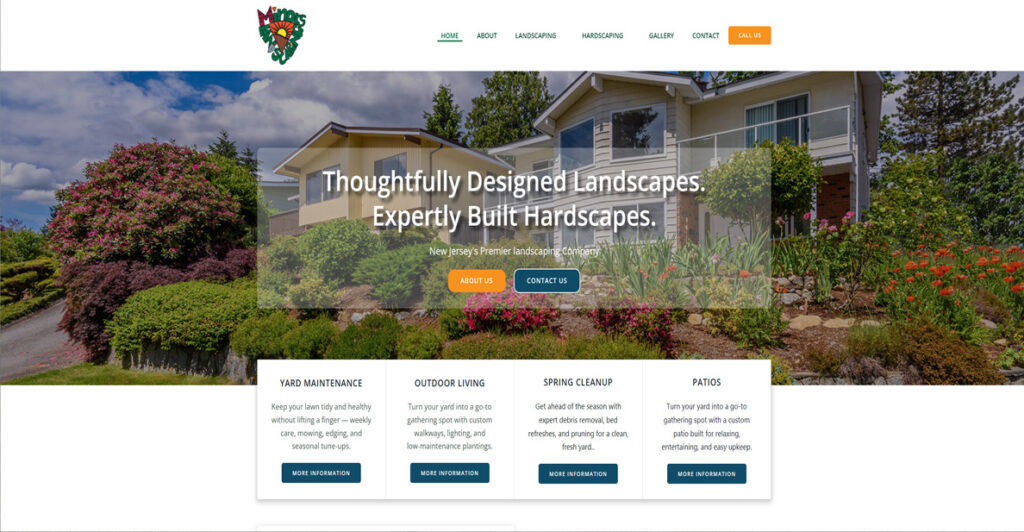
A homeowner in Tewksbury planning a $60,000 backyard transformation isn’t searching for “full-service landscaping.” They’re typing things like “landscape designer near me,” “outdoor living designer NJ,” “patio installer Hunterdon County,” or “landscape design and install Bedminster.” When they land on your site, they want immediate confirmation that yes, this is what you do.
When your homepage lumps mowing, mulching, leaf cleanup, and $80K hardscape installs together under one “Landscape Services” heading, you become invisible to the high-end customer and end up competing on price with every $30-a-cut operation in the county.
Pick what you actually want to sell more of — landscape design, hardscape, outdoor living, garden design, native plant work — and make that the dominant message up top. Mention the rest, but lead with what you want to be known for. Something like “Custom landscape design and installation for high-end homes across Hunterdon, Warren, and Western Somerset County” will outperform a generic homepage every time, because it’s selecting the right customer the second they arrive.
2. Your portfolio photos are doing more damage than you realize
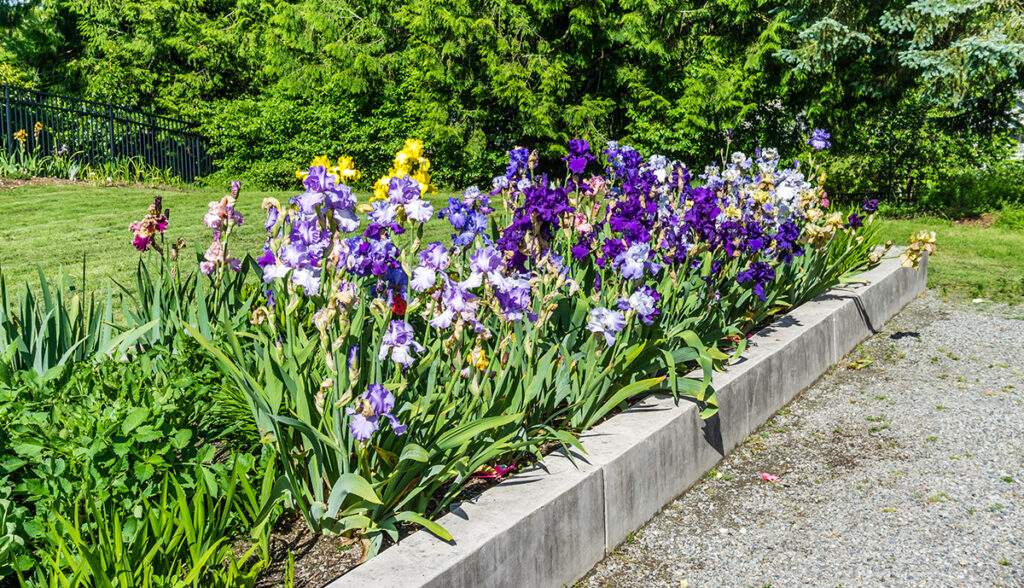
Landscaping is the most visual trade there is. A homeowner about to spend $40K-plus on outdoor living space is deciding based on what they see you’ve already built, not what you say about yourself.
And yet, on most landscape sites around here, the portfolio falls into one of three categories: a handful of phone photos shot in flat midday light with a truck or trailer in the corner of the frame, after-photos with no befores so the transformation story is missing entirely, or an unlabeled grid of images that all blur together because there’s no context about what the project was, where it was, or what it cost.
Any one of those is a dealbreaker for a high-end buyer.
Good portfolio photos are shot in golden-hour light, not at noon. They include multiple angles of the same project, with at least one wide establishing shot. Real before-and-afters get paired so the story is obvious. Each image gets a caption with the town, project type, materials, and scale of the work. And the filenames matter — tewksbury-nj-flagstone-patio-with-fire-pit.jpg ranks better than IMG_2847.jpg.
If you don’t have professional photos of your best work, this is probably the highest-ROI thing you can fix before spring hits. A single half-day shoot of one or two of your strongest recent projects can produce 30 to 50 portfolio-grade images that’ll work harder for your business than anything else you spend marketing money on this year.
3. You have no service area pages — just “we serve NJ”
This is where most landscape companies lose the local SEO game without ever knowing they’re playing it.A homeowner in Lebanon Township searching for “landscape designer Lebanon Township NJ” doesn’t want to land on a generic homepage about serving “all of New Jersey.” They want to see Lebanon Township on the page. They want to know you’ve worked nearby. They want photos of projects within driving distance.
Google works the same way. It ranks pages that specifically match the searched location, not pages that vaguely gesture at the state.
Build dedicated service area pages for the towns where your best customers live. For most design and hardscape companies up here, that means somewhere in this neighborhood:
- Hunterdon: Tewksbury, Readington, Clinton Township, Lebanon Township, Califon, Oldwick, Whitehouse Station
- Warren: Washington Township, Mansfield, Independence Township, Hope, Liberty Township
- Western Somerset: Bedminster, Far Hills, Peapack-Gladstone
Each page should have real content (not just the town name swapped in), two or three photos of nearby projects, some local context — terrain, soil, common property types, what people in that town tend to ask for — and a clear quote-request form. A company with five solid town pages will out-rank a competitor with one generic homepage every time, even if the competitor’s been around twenty years longer.
4. You’re invisible in Google’s Map Pack
When a homeowner Googles “landscape designer near me” or “patio installer Hunterdon County,” the first thing they see is a map with three local business listings under it. That’s the Google Map Pack, and the three companies showing up there capture roughly half the resulting calls. If you’re not in that top three, you’re invisible for the searches that matter most.
Getting into the Map Pack comes down to a few things:
- A fully optimized Google Business Profile — not just claimed, actually optimized
- A consistent name, address, and phone number across the web
- Twenty-plus current photos of real projects on your GBP (not stock landscaping images)
- A steady stream of reviews — most local landscapers have somewhere between 3 and 15, so getting to 30-plus pushes you past most of your competition
- Regular Google Posts showing recent work, which almost nobody in this trade is doing
- Service categories set correctly — “Landscape Designer,” “Landscape Architect,” “Landscape Lighting Designer,” not just the generic “Landscaper”
This is the single fastest lever you’ve got. A well-optimized GBP can move you into the Map Pack in 30 to 90 days, often without changing your actual website at all. Most landscapers around here haven’t done the work, so the bar to outrank them is genuinely low.
5. Your site is slow on a phone — and that’s where your customers are
The majority of “landscape designer near me” searches happen on mobile. A homeowner is standing in their backyard, looking at the space they want transformed, pulling up landscape companies on their phone. If your site takes more than three seconds to load on cell data, a big chunk of those visitors are gone before your homepage even finishes painting.
The easiest test: open your site on your phone, off WiFi, and count the seconds from the moment you tap until everything’s loaded and usable. If it’s over three, you’ve got a problem.
The culprit is almost always huge, unoptimized photos. A 6 MB iPhone image dropped straight onto a page can take 5 to 10 seconds to load over cell data. The fix is technical — image compression, lazy loading, decent hosting — but it’s solvable, and the bump in lead volume is immediate.
6. There’s no obvious way to request a quote on every page
Most landscape sites bury the contact form on a “Contact Us” page nobody visits. That’s not how high-ticket buyers behave. When someone’s sitting on your portfolio page looking at a flagstone patio that’s exactly what they want, they should be able to request a quote right there — not hunt for “Contact Us” in the menu and fill out a generic form.
A few things that work: a “Request a Free Design Consultation” button on every service page, a short form (four or five fields — name, email, phone, project type, optional message), a CTA that names what they’re getting (“Schedule My Free Design Consultation” beats “Submit”), and a tap-to-call phone number visible at the top of every mobile page. Companies that make this easy get noticeably more leads than the ones whose contact info is buried two clicks deep.
7. You have no reviews — or your last one was three years ago
Landscape design is a high-trust purchase. Someone is letting strangers onto their property for weeks at a time, trusting them with $25K to $100K-plus of investment. Before they call you, they’re reading your reviews.
Five reviews from 2021 makes you look like a business that might not even be around anymore. Fifty reviews with recent dates makes you the obvious call.
It doesn’t take much to fix. After every completed project, send the client a one-line email with a direct link to your Google review page. Add the same request to your invoice or final walkthrough. Ask in person at the end of the job, then follow up digitally. Most companies don’t do this with any consistency, which is why most have 10 reviews. The ones who keep at it end up with 50 to 100-plus and pull the lion’s share of calls.
What to actually do, in order
If you’re reading this in late winter and you want to be ready for spring, here’s how I’d sequence it.
This week: Test your site on your phone and actually time it. Google your business name and look at your GBP — does it have 20-plus photos and recent activity? Look at your homepage with fresh eyes: does it say specifically what kind of work you do, or is it generic?
This month: Get a professional photo shoot of your two or three best recent projects booked before the spring rush. Build out service area pages for the three to five towns where your best work lives. Set up a real review collection process — and don’t skip going back to past clients, plenty of them will leave a review if you ask directly.
Before April 1: Clean up the technical stuff — load times, broken links, missing forms. Finish optimizing your GBP and start posting weekly. Make sure every service page has a quote-request form people can actually see.
When it makes sense to hand this off
If you’re running a landscape company doing $500K to $3M-plus a year, you’re past the point where doing this yourself is the best use of your time. The hours you’d spend rebuilding the site, learning local SEO, and babysitting your Google Business Profile are hours you’re not on jobs that actually pay.
We’re a small Hampton, NJ studio that’s been doing this since 1999. We take on a limited number of landscape design, hardscape, and outdoor living companies each year, and we shoot the photography ourselves so your portfolio doesn’t end up as an afterthought.
If you’d like a free, honest look at your current site and local SEO setup — no pitch, no obligation — we offer a free audit for NJ landscape companies. You’ll get a 5-minute video walkthrough, a one-page summary of the biggest opportunities, and a straight answer on whether you’d benefit from professional help or whether this is something you can handle on your own.
Or if you’d rather just talk, give us a call at (908) 574-0126. We answer the phone Monday through Friday, 9 to 5.